Bookmaker Margins: What the Overround Tells You
 Updated 4 October 2026
 For readers in Ireland, 18+
The margin is the bookmaker’s cut built into every price. This guide shows how to work it out from a set of prices, with a worked example on an invented market, and what the number does and does not tell you.
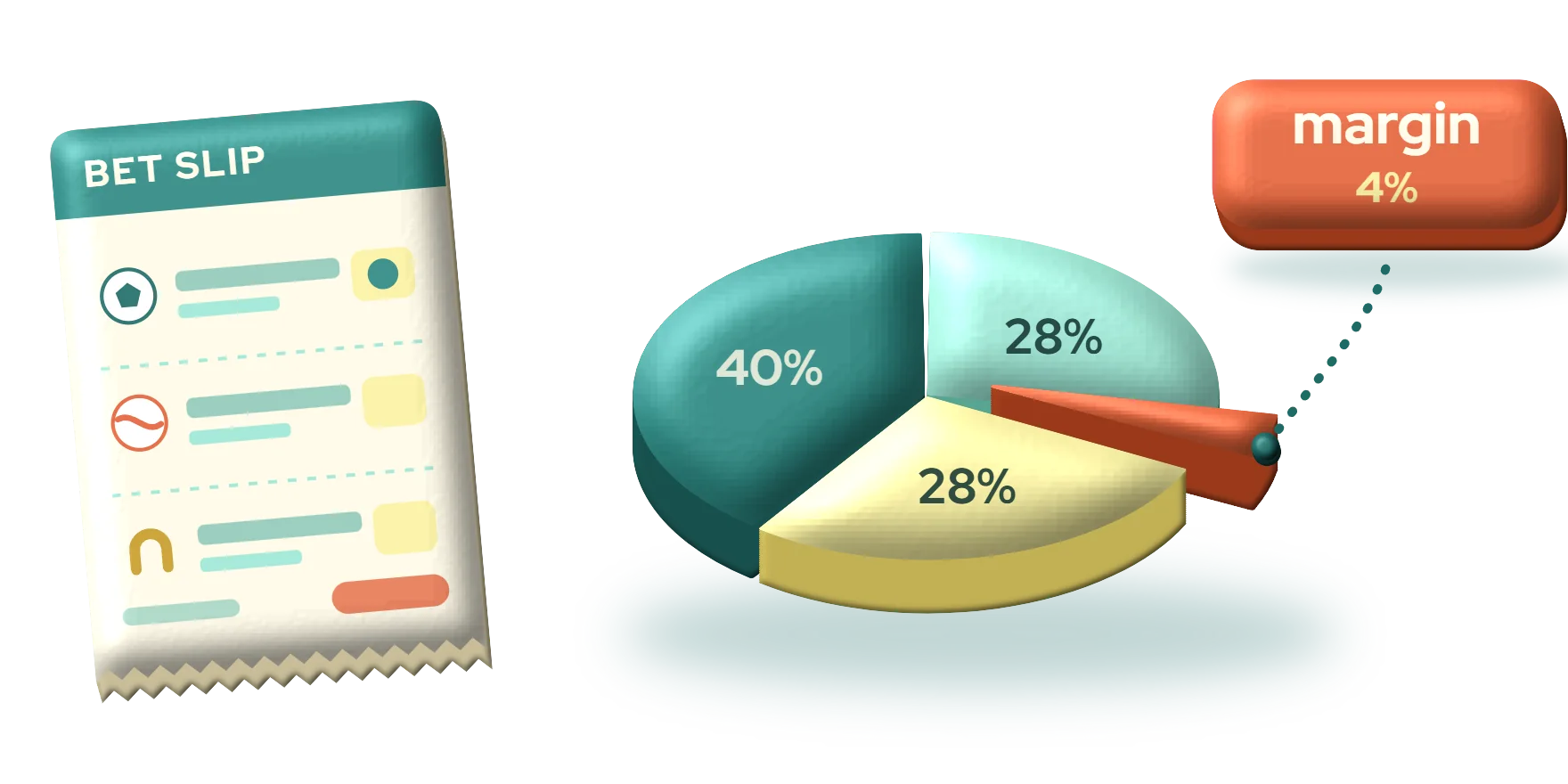
Price and probability
Every price a bookmaker shows can be turned into a probability. That probability, called the implied probability, is the starting point for everything on this page: total the implied probabilities of a whole market and the result tells you how much margin the bookmaker has built into the prices.
A bookmaker’s margin, also called the overround, the vig or the juice, is the bookmaker’s cut built into every price. It is not charged as a separate fee. It sits inside the numbers, which is why it is easy to miss and worth understanding.
From a decimal price
The decimal price is the total return for each €1 staked, including the stake. The implied probability is one divided by the price:
Implied probability = 1 ÷ decimal price
A price of 2.00 implies 50%. A price of 4.00 implies 25%. A price of 1.25 implies 80%.
From a fractional price
A fractional price a/b shows the winnings for a stake of b, without the stake. The implied probability is b divided by (a + b):
Implied probability = b ÷ (a + b)
So 3/1 implies 1 ÷ 4 = 25%, and 4/6 implies 6 ÷ 10 = 60%. To turn a fractional price into a decimal one, divide a by b and add 1: 5/2 becomes 3.50.
Conversion table
| Fractional price | Decimal price | Implied probability |
|---|---|---|
| 1/2 | 1.50 | 66.7% |
| 4/6 | 1.67 | 60.0% |
| evens | 2.00 | 50.0% |
| 11/10 | 2.10 | 47.6% |
| 6/4 | 2.50 | 40.0% |
| 2/1 | 3.00 | 33.3% |
| 5/2 | 3.50 | 28.6% |
| 3/1 | 4.00 | 25.0% |
| 4/1 | 5.00 | 20.0% |
| 10/1 | 11.00 | 9.1% |
Price formats themselves are not the subject of this guide; what matters here is the probability behind each price. A lower price means the bookmaker rates the outcome as more likely; a higher price, less likely.
Adding up the book
A market is a complete set of outcomes, exactly one of which will happen: home win, draw or away win; or every runner in a race. If a bookmaker’s prices reflected the probabilities exactly and nothing more, the implied probabilities of all the outcomes would add up to 100%. In practice they add up to more. That total is called the book, or the book percentage.
Book percentage = sum of (1 ÷ price) across every outcome in the market
Two ways to quote the margin
Once you have the book percentage, there are two common ways to express the margin, and different websites use different ones. Always check which one a figure means.
- Overround = book percentage − 100%. A book of 105% has an overround of 5%.
- Margin (theoretical hold) = 1 − (1 ÷ book). A book of 105% gives a margin of 4.76%: the share of all stakes the bookmaker would keep if money came in exactly in proportion to the prices.
The mirror image of the margin is the theoretical return to bettors: 1 ÷ book. For a book of 105%, that is 95.24%. Out of every €100 staked across the whole market in those proportions, €95.24 comes back to bettors as returns and €4.76 stays with the bookmaker.
Conditions for a fair calculation
- Use every outcome. If one runner or one result is missing, the total is wrong. Markets with an “any other” option must include it.
- Use prices from the same moment. Prices move. A total built from prices taken minutes apart can be off.
- Use one market at one bookmaker. Mixing the highest price for each outcome from several bookmakers gives a different number, which says something about the market as a whole, not about any one bookmaker.
- Check the settlement rules. Dead heats, void outcomes and withdrawn runners can change what a price is worth after the event.
Worked example
Illustration only: invented prices on an invented market. They are not prices from any bookmaker in the atlas, not a measurement and not a forecast of any real event.
A two-way market
Take an invented match with no draw option: Team North v Team South, both priced at 1.91. Each price implies 52.36%, and the two add up to 104.71%. The overround is 4.71%; the margin is 1 − (1 ÷ 1.0471) = 4.50%. A bettor who could back both sides in proportion would get back 95.50% of the money staked, whichever side wins.
The same market without a margin would price both sides at 2.00: a 50% chance each, a book of exactly 100%.
A three-way market
Now an invented three-way market: Team North 2.10, Draw 3.40, Team South 3.60. The table works through each step.
| Outcome | Price (decimal) | Implied probability | Probability with margin removed | Price with margin removed |
|---|---|---|---|---|
| Team North | 2.10 | 47.62% | 45.43% | 2.20 |
| Draw | 3.40 | 29.41% | 28.06% | 3.56 |
| Team South | 3.60 | 27.78% | 26.50% | 3.77 |
| Total | 104.81% | 100.00% |
The book is 104.81%, so the overround is 4.81% and the margin is 4.59%. The last two columns remove the margin by the simplest method, dividing each implied probability by the book so that they add up to 100% again. Other methods spread the margin unevenly, for example more on the outsider than on the favourite; they give slightly different “fair” prices but the same book percentage.
Following the money
Suppose the bookmaker took stakes on this invented market in exact proportion to its prices, so that each outcome would return €100.
| Outcome | Price | Stake taken on it | Return if it wins |
|---|---|---|---|
| Team North | 2.10 | €47.62 | €100.00 |
| Draw | 3.40 | €29.41 | €100.00 |
| Team South | 3.60 | €27.78 | €100.00 |
| All three | €104.81 | €100.00 whichever result |
The bookmaker takes €104.81 in stakes and returns €100.00 whichever result happens. It keeps €4.81, which is 4.59% of the money staked: exactly the margin. That is what the margin means. It is the bookmaker’s share across the whole market when the book is balanced, not a fee on any single bet.
A six-runner race
The same method works for an invented race with six runners priced in fractions.
| Runner | Fractional | Decimal | Implied probability |
|---|---|---|---|
| Runner 1 | 2/1 | 3.00 | 33.33% |
| Runner 2 | 3/1 | 4.00 | 25.00% |
| Runner 3 | 4/1 | 5.00 | 20.00% |
| Runner 4 | 6/1 | 7.00 | 14.29% |
| Runner 5 | 8/1 | 9.00 | 11.11% |
| Runner 6 | 10/1 | 11.00 | 9.09% |
| Total | 112.82% |
The book is 112.82%: an overround of 12.82% and a margin of 11.36%. We chose these numbers to show that a market with more outcomes gives more prices for a margin to sit in; they do not describe what any bookmaker actually charges on racing.
Doing it yourself
- Write down the price of every outcome in one market, at one bookmaker, at one moment.
- Convert each to an implied probability (1 ÷ decimal price).
- Add them up. That is the book percentage.
- Subtract 100% for the overround, or calculate 1 − (1 ÷ book) for the margin.
- Note the date and time, because the answer changes when the prices change.
Margins by market type
We do not publish typical margins by sport or market, because we have not measured them on a dated sample. What we can explain is the arithmetic that makes margins differ between kinds of market. Each point below follows from the formulas above; none is a measurement.
Number of outcomes
A two-way market has two prices; a big race may have twenty or more. Each price can carry a little of the margin, so a small trim on many prices adds up to a large book percentage. The invented six-runner race above shows the effect: modest-looking fractions, but a book of 112.82%.
Accumulators multiply margins
An accumulator multiplies the prices of its selections, and in doing so it multiplies the margins as well. If every selection comes from a market like the invented two-way example above, with a theoretical return of 95.50% on each, the return on the combined bet is that figure multiplied by itself once per selection.
| Selections in the accumulator | Theoretical return to bettors | Theoretical margin |
|---|---|---|
| 1 | 95.50% | 4.50% |
| 2 | 91.20% | 8.80% |
| 3 | 87.10% | 12.90% |
| 4 | 83.18% | 16.82% |
| 6 | 75.86% | 24.14% |
| 8 | 69.19% | 30.81% |
Illustration only, using the invented 1.91/1.91 market for every selection. The point is mechanical: the more selections, the larger the share of the stake that the margin takes over time.
Combined bets built inside one event
Bets that combine several outcomes from the same event are priced by the bookmaker as one combined price. Because the full set of possible combinations is not shown, the method on this page cannot be applied: you cannot add up a book that is not displayed. That is a limit of the calculation, not a judgement on the product.
Prices during an event
In-play prices change from moment to moment, and a market can be suspended. A book percentage calculated during an event describes that moment only. To compare bookmakers, prices have to be taken at the same time on the same market.
Long-range markets
Markets on the winner of a whole competition, set weeks or months ahead, list many outcomes, and some may not be priced at all. Check that the market is complete before adding it up; otherwise the total understates the book.
How the atlas measures pricing
Pricing is one of the six criteria in the atlas score, with a published weight of 10%. It is the only criterion we do not score yet. Every bookmaker’s operator file shows Pricing as “not scored yet”, and the score is built from the other five criteria.
How the score works without Pricing
The atlas score is a weighted average of the criteria that have a score. While Pricing has none, the other five weights, which add up to 90%, are scaled up proportionally so that together they count for 100%. The weights themselves do not change.
| Criterion | Published weight | Weight while Pricing is not scored |
|---|---|---|
| Licence & register | 30% | 33.3% |
| Safer-betting tools | 20% | 22.2% |
| Payments & withdrawal terms | 15% | 16.7% |
| Market coverage | 15% | 16.7% |
| Pricing | 10% | not scored yet |
| Support & complaints | 10% | 11.1% |
What a Pricing score will need
A margin figure is only meaningful when it is comparable. Before we score Pricing, we need a dated sample:
- the same markets at every bookmaker in the atlas, chosen in advance and listed on the page;
- prices captured at the same time, with the date and time published;
- complete markets only, calculated with the book percentage method on this page;
- a repeat of the sample over time, so one unusual day does not decide a score.
Until that sample exists, we leave Pricing blank rather than estimate it. Commission from bookmakers does not affect any score, Pricing included. The methodology sets out every criterion and weight, and each operator file shows the scores that do exist.
What margin does not tell you
The margin is a useful number with narrow limits. It describes prices, not bookmakers as a whole and not your chances on any one bet.
- It is not your chance of winning. A low margin does not raise the chance that a bet wins. Each bet is settled on the result, whatever the margin on the market.
- It is theoretical. The margin is what the bookmaker would keep if stakes matched the prices exactly. Real books are rarely balanced, and the bookmaker’s actual result on a market can be higher, lower or a loss.
- It says nothing about the licence. Whether a bookmaker holds a GRAI remote betting licence is a separate question; check it on the GRAI register or with our guide How to check a licence.
- It says nothing about payments, limits or complaints. Withdrawal terms, identity checks and safer-betting tools are separate criteria. See Paying in and withdrawing and Complaints about a bookmaker.
- It changes. A margin calculated today may not hold tomorrow.
Exchanges work differently
A betting exchange does not set prices; it lets bettors back and lay against each other and charges for providing that facility, usually as a commission. The Gambling Regulation Act 2024 measures an intermediary’s turnover as the charges paid for providing the facility, and exchanges hold a different GRAI licence: remote betting intermediary (RBI), not remote betting (RB). The atlas covers RB licence holders only. Our guide Betting exchanges and bookmakers explains the difference.
The margin and your budget
Over many bets, the margin works against the bettor: that is how a bookmaker’s prices are built. Betting costs money and most bets lose. Treat any stake as the price of entertainment and set a deposit limit before you start. Money lost on a bet is spent; staking more to recover it only adds to the cost. If betting is affecting your money or your mood, the GamblingCare National Helpline is free and open 24 hours a day on 1800 936 725; the HSE Drugs & Alcohol Helpline is 1800 459 459. More services are listed on our responsible gambling page.
What is a bookmaker’s margin?
It is the bookmaker’s cut built into its prices. In any market, the implied probabilities of the outcomes total more than 100%; the excess is the overround, and the margin is the share of stakes the bookmaker would keep on a balanced book.
How do I calculate the overround?
Convert every price in one market to an implied probability (1 divided by the decimal price), add them up and subtract 100%. For the margin as a share of stakes, calculate 1 minus 1 divided by the book percentage.
What is the difference between overround and margin?
They are two ways of expressing the same book. A book of 105% has an overround of 5% and a margin of 4.76%. Check which one a published figure uses before comparing numbers.
Does a lower margin mean I am more likely to win?
No. The margin describes how the prices are built across a whole market. It does not change the chance of any outcome. Betting costs money and most bets lose.
Does the atlas publish margins for each bookmaker?
Not yet. Pricing (weight 10%) is not scored until we have a dated sample of the same markets at every bookmaker, captured at the same time. Until then, operator files show Pricing as not scored yet.
Why do accumulators carry a larger margin?
An accumulator multiplies the prices of its selections, so it multiplies their margins too. The theoretical return falls with every selection added, as the illustration on this page shows.
Do betting exchanges have a margin?
Exchanges do not set prices; they charge for providing the facility, usually as a commission, and hold a remote betting intermediary licence from GRAI. The atlas covers remote betting licence holders only.